The Complicated Business of SF₆-Free Switchgear
Vacuum interruption, alternative gas mixtures, and why the differences matter for high-voltage GIS.
PROJECT DETAILS
Content Type
Buyer Explainer / Industry Analysis / Industry Thought Leadership
History of GIS and SF6
Gas-insulated switchgear (GIS) became a commercial alternative to conventional air-insulated switchgear (AIS) in the 1960s. By enclosing high-voltage components in metal housings filled with insulating gas, GIS can reduce a substation’s footprint by as much as 90% compared to AIS. It can also be installed inside buildings, underground, and offshore, making it an increasingly popular option in today’s ever-changing grid. You’ll find GIS often in urban areas and connected to renewable energy projects for that reason. Due to its customizable configurations, it’s also an attractive option for the chemical, oil and gas, semiconductor, and data center industries. [1]
During the development of GIS, several gases were explored as insulating materials. By the late 1960s, sulfur hexafluoride (SF₆) had emerged as an industry favorite due to its strong dielectric properties, meaning its ability to withstand high electrical voltages without breaking down, and its effective arc-quenching capabilities when interrupting electrical faults. [1]
It’s safe to say all major GIS manufacturers have offered SF₆ equipment, and an established supply chain has helped keep the insulating gas relatively affordable. Additionally, the technology is common and engineering, procurement, and construction (EPC) contractors are well-versed in installing and commissioning these various pieces of equipment, which also helps keep costs down.
If SF6 is so effective, why have SF6 alternatives started popping up in the market?
SF₆’s main trade-off is that it’s a potent greenhouse gas, with a global warming potential approximately 24,300 times that of CO₂ over a 100-year period. [2] This contributes to the environmental footprint of utilities and companies that purchase equipment containing it, particularly when gas escapes during operation, maintenance, or disposal.
As more companies impose aggressive sustainability goals and governments introduce greenhouse gas emission requirements, manufacturers are seeking to provide alternatives in an increasingly competitive market.
In Europe, the pressure is particularly significant. The EU’s revised F-gas regulation restricts the use of fluorinated greenhouse gases with a global warming potential of 1 or greater in new electrical switchgear on a phased schedule, with high-voltage restrictions beginning in 2028 and expanding in 2032, subject to certain exceptions. [3]
Two Approaches to SF₆-Free GIS
Both approaches can use gases for insulation, but they differ in how they interrupt electrical arcs. Conventional SF₆ circuit breakers use gas to extinguish the arc, while vacuum interrupters do so inside a sealed vacuum chamber. This allows vacuum-based GIS to use non-fluorinated gases, such as clean air, for insulation. The other approach uses alternative fluorinated gas mixtures with a substantially smaller greenhouse gas footprint than SF₆, retaining a gas-based method of interruption.
If these are already options in the market, why wouldn’t buyers migrate en masse toward newer, greener equipment? Removing SF₆ from GIS isn’t always a one-for-one changeout, and the consequences can cascade well beyond the switchgear itself.
Vacuum Interruption: Eliminating Fluorinated Gases
Vacuum interruption, often associated with clean-air technology, uses a different method of interrupting current than conventional SF₆ circuit breakers. When a circuit breaker opens, its electrical contacts separate, but electricity can briefly continue jumping between them, creating an electrical arc. Rather than relying on an insulating gas to extinguish the electrical arc, the circuit breaker separates its contacts inside a sealed vacuum chamber. With almost no gas molecules present, the arc extinguishes as the alternating current passes through zero. The surrounding GIS components can then use clean air or another non-fluorinated insulating medium.
One of the biggest benefits is eliminating the need for fluorinated insulating gases altogether. That means no SF₆ or C4-FN emissions from the insulating medium, along with fewer requirements for specialized fluorinated-gas handling, maintenance, and recovery. Particularly at medium voltages, vacuum interruption is also a well-established technology, boosting buyers’ confidence through existing operating experience. [4]
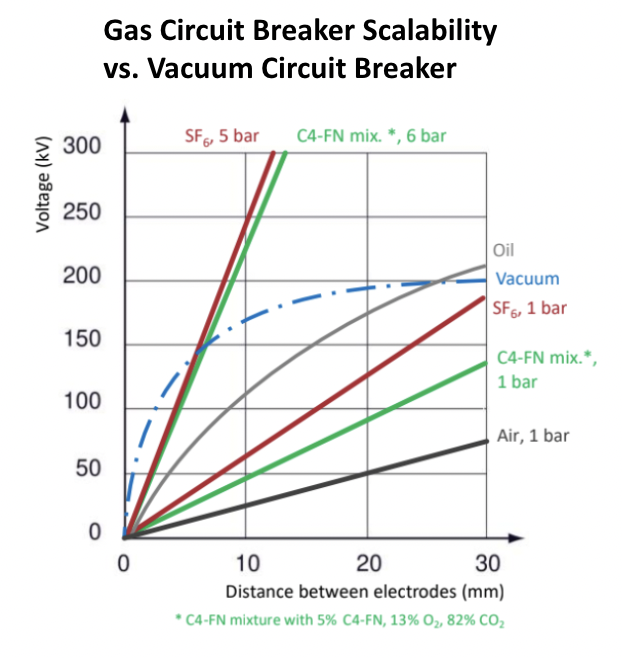
Scaling vacuum interruption to higher voltages, however, can present engineering challenges. Higher voltages require greater insulation clearances, meaning more distance between energized components to prevent electrical breakdown. In the comparison shown in Figure 2, clearance requirements increase more sharply around 150 kV, which can significantly increase equipment size and limit compact applications, depending on the insulating medium and equipment design. Although suppliers are actively working to research and develop new offerings, this remains an important consideration for higher-voltage installations where space is limited. [5]
Other design challenges may include transient overvoltages from the different switching characteristics of vacuum interrupters. In certain applications, such as switching transformers or reactors, vacuum interrupters can stop current so abruptly that brief voltage spikes occur. These spikes can put additional stress on surrounding equipment, sometimes requiring protective devices to manage them. [6]
Alternative Gas Mixtures: Keeping a Familiar Approach
Some vendors have developed alternative gas technologies utilizing fluoronitrile-based mixtures, largely C4-FN. These mixtures generally combine a small concentration of C4-FN with carrier gases such as CO₂ and O₂, allowing manufacturers to retain a gas-insulated design with strong dielectric performance, while substantially reducing its greenhouse gas impact.
That said, GIS equipment has a lifespan measured in decades, and even with increasing demand, adoption takes time. Alternative gas mixtures can carry higher procurement and servicing costs than conventional SF₆, making gas availability, handling equipment, and long-term supply important considerations over the equipment’s life.
Why C4-FN?
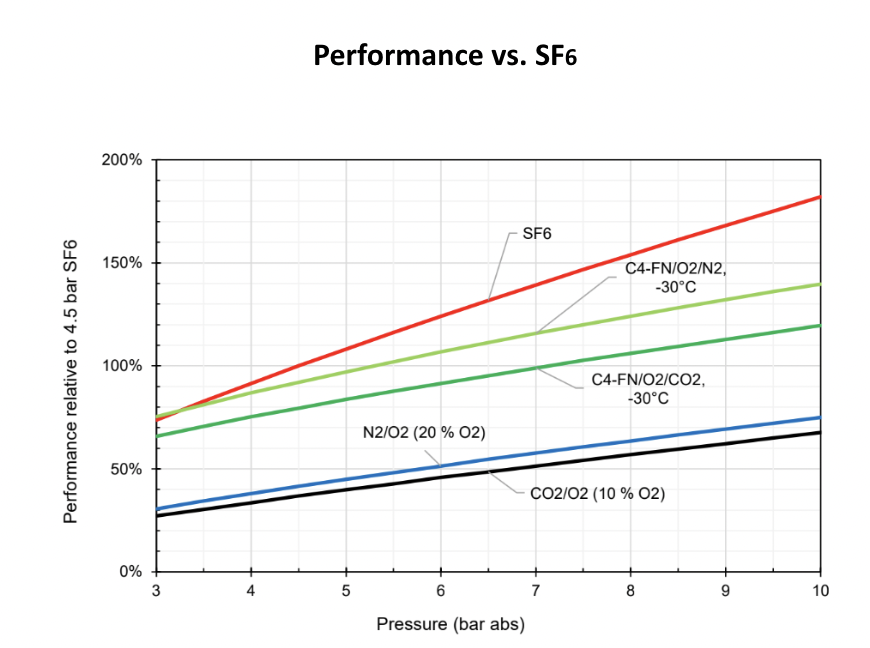
In alternate gas mixtures, C4-FN is the component that offers strong dielectric performance, helping manufacturers achieve high-voltage insulation requirements. These alternate mixtures are carefully engineered to account for differences in gas concentration, pressure, and temperature required to maintain performance comparable to SF₆.
It can be mixed because C4-FN actually has greater dielectric strength than SF₆, meaning it can be used in smaller quantities for a similar result. This is a good thing because pure C4-FN can liquefy at relatively low ambient temperatures, so it must be mixed with carrier gases like CO₂ to lower its concentration and partial pressure, helping it remain in its gaseous state across the equipment’s operating temperature range. Temperature matters because C4-FN has a higher liquefaction temperature than SF₆, meaning it’s more likely to turn into a liquid as temperatures drop, which can reduce the amount of gas available for insulation. [7]
This small quantity of C4-FN can reduce the global warming potential of the insulating medium by more than 90% compared with SF₆, although the exact reduction depends on the formulation. [7] That said, it’s important to note it does still contain fluorinated greenhouse gases, so for regulations like those previously discussed in the EU, other technologies may still be preferred.
Figure 1. Comparative dielectric strength of SF₆ and C4-FN insulating gases. Source: Hitachi Energy [5].
The caveat to that is when exceptions are needed. One possible circumstance could be for environments where transmission voltages above 145 kV are needed but space is limited, such as urban substations or offshore wind generation platforms. As previously discussed, vacuum-based GIS can grow considerably in size at higher voltages, but one way in which C4-FN and SF₆ GIS are similar is in size. As the second figure illustrates, C4-FN mixtures can maintain shorter insulation clearances at increasing voltages, allowing energized components to remain closer together and helping preserve the compact dimensions of conventional SF₆ GIS.
Figure 2. Comparison of insulation clearance requirements at increasing voltage levels. Source: Hitachi Energy [5].
Utilities are asking about warranties and long-term support for equipment with such long lifespans. If these alternatives are newer to the market and models change with each iteration, what does the support structure look like for older GIS models?
Beyond the initial equipment cost, buyers also have to consider how the technology fits into the rest of the substation. Will the alternative require changes to the layout, insulation coordination, protection studies, or installation procedures? And will it meet the project’s environmental requirements by the time it’s commissioned?
Maintenance is another consideration, particularly when it comes to specialized equipment, replacement parts, and personnel training. And while the environmental benefit is an important part of the evaluation, it doesn’t necessarily override cost, lead time, or reliability requirements.
Expect longer RFP cycles when evaluating these alternative technologies, particularly for organizations qualifying a new design for the first time.
For OEMs, early customer references and documented operating experience can help address some of the uncertainty. One consideration is negotiating permission to publish customer case studies or testimonials as part of the original contract, rather than requesting approval after commissioning. These examples can help prospective buyers understand how the technology has performed in comparable applications.
More Than a Gas Replacement
SF₆-free GIS isn’t always a direct replacement for conventional equipment. Buyers still have to consider the surrounding substation design, maintenance requirements, and long-term costs. A lower greenhouse gas footprint is an advantage, but it’s only one part of the equipment specification.
References
[1] GE Vernova, “The History of Gas-Insulated Substations.” [Online]. Available: https://www.gevernova.com/electrification/articles/the-history-of-gas-insulated-substations
[2] German Environment Agency, “Switchgear.” [Online]. Available: https://www.umweltbundesamt.de/en/topics/climate-energy/fluorinated-greenhouse-gases-fully-halogenated-cfcs/application-domains-emission-reduction/switchgear
[3] European Parliament and Council, “Regulation (EU) 2024/573 on fluorinated greenhouse gases,” 2024, Art. 13 and Annex IV. [Online]. Available: https://eur-lex.europa.eu/eli/reg/2024/573/oj/eng
[4] Siemens Energy, “Industry Initiative to Reduce F-Gases.” [Online]. Available: https://www.siemens-energy.com/us/en/home/stories/industry-initiative-to-reduce-f-gases.html
[5] Hitachi Energy, “[Exact publication title and year to be confirmed],” document 9AKK108468A1219. [Online]. Available: https://publisher.hitachienergy.com/preview?DocumentID=9AKK108468A1219&LanguageCode=en&DocumentPartId=&Action=Launch
[6] M. Seeger, F. Macedo, U. Riechert, and M. Bujotzek, “Trends in High Voltage Switchgear Research and Technology,” IEEJ Transactions on Electrical and Electronic Engineering, vol. 20, no. 3, pp. 322–338, 2025. https://doi.org/10.1002/tee.24244
[7] GE Vernova, C4-FN Mixtures for High-Voltage Equipment, Aug. 22, 2024. [Online]. Available: https://www.gevernova.com/electrification/sites/default/files/resources/products/reference/c4-fn_handbook.pdf
Target Audience
Electrical equipment manufacturers, utilities, consulting engineers, and technical decision-makers.
Project Overview
A technical explainer examining the transition toward SF₆-free gas-insulated switchgear, the differences between emerging technologies, and the engineering and commercial considerations influencing equipment selection.
PORTFOLIO NOTE
PORTFOLIO NOTE: This piece is part of the GridLines writing portfolio, showcasing the types of technical, industry-focused, and executive content I develop for clients. Each engagement is tailored to the client's expertise, audience, objectives, and preferred voice. Where applicable, confidential information has been removed, anonymized, or replaced with illustrative details.
WRITING SAMPLE
The Complicated Business of SF₆-Free Switchgear
Vacuum interruption, alternative gas mixtures, and why the differences matter for high-voltage GIS.
Your expertise. Thoughtfully articulated.
GridLines helps energy and industrial companies communicate complex ideas, establish industry authority, and turn technical expertise into compelling content.
Every engagement begins with a conversation about your business, audience, and content goals.
Service packages and rates available upon request.