Before You Request a GIS Quote: What Your OEM Needs to Know
An engineer's guide to the technical information manufacturers need to develop an accurate high-voltage GIS proposal.

PROJECT DETAILS
Content Type
Technical Explainer / Buyer Education / Sales Enablement
A GIS quote is only as good as the RFQ behind it. When a manufacturer gets a package with a spec copied from the last project, no single-line diagram, and “TBD” in half the rating fields, clarification rounds are unavoidable, and one of two things happens. The technical clarifications go back and forth, extending the bid process for everyone, or the clarifications are missed by the bidder and come back as change orders six months after award.
Neither is great if you’re trying to hit an energization date. The second one is how the low bid ends up being the expensive one.
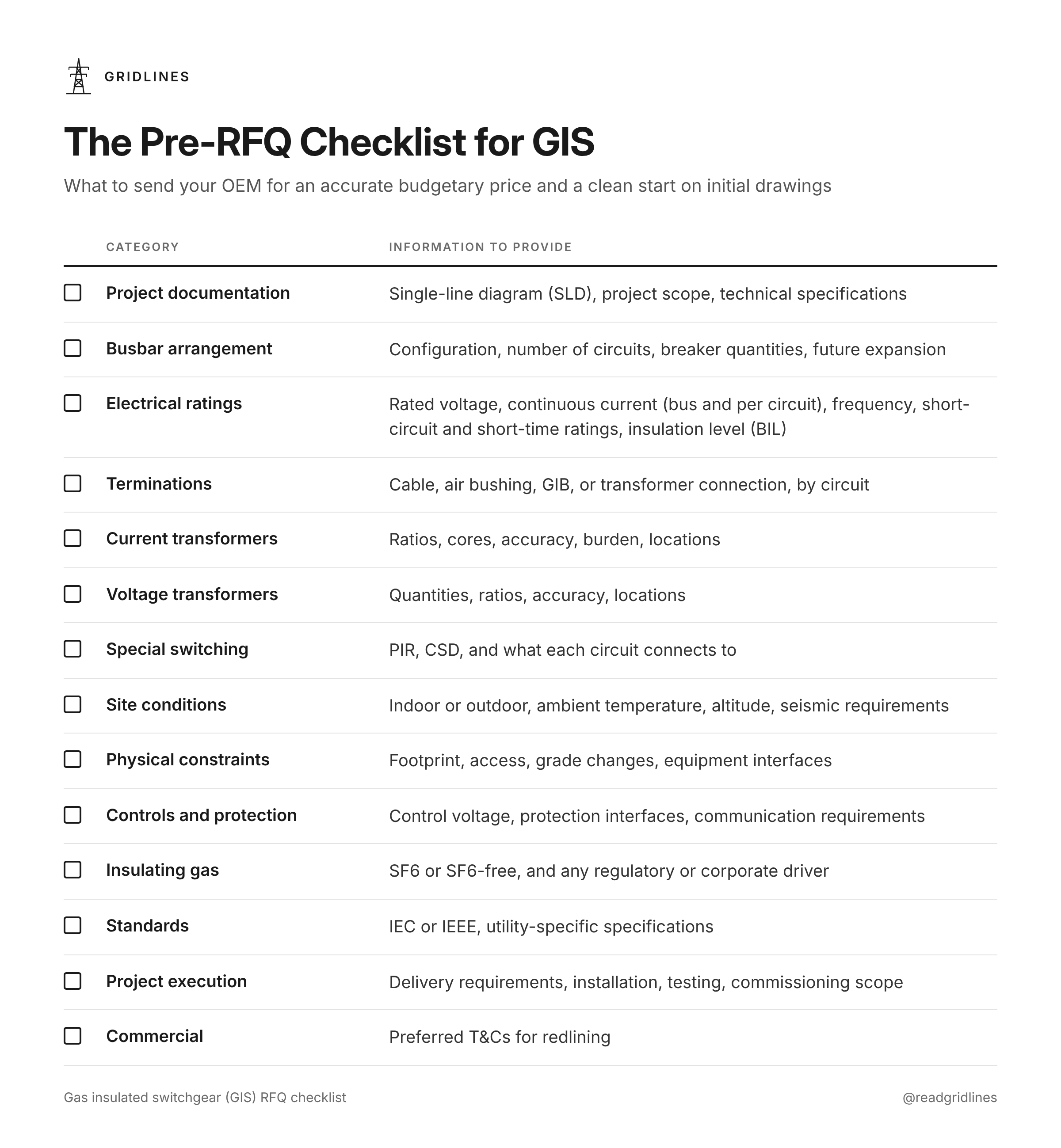
Below is what a gas insulated switchgear (GIS) OEM actually needs to give you an accurate budgetary price. It won’t eliminate every engineering question or clarification, but it will cut out the back-and-forth and the upfront wait before engineering drawings can begin.
1. Start With the Single-Line Diagram
Always start with the single-line diagram (SLD). If you don’t send one, you’ll almost certainly be asked for one, so you may as well save a round of emails. Even a sketch on a napkin tells an OEM more than a page of spec text. From one image we can see the busbar configuration, and from there, the number of exits, the number of circuit breakers, where the disconnects and grounding switches sit, and more depending on how well it’s labeled.
The busbar configuration is the part to get right first, because it sets the breaker count, and the breaker count drives most of the price. These are the ones that come up most often:
Single bus, single breaker (SBSB). One bus, one breaker per circuit. Smallest and cheapest, but a bus fault or bus outage takes everything down with it.
Single breaker, double bus (SBDB). One breaker per circuit, and each circuit can be switched to either of two buses through a bus coupler. This is the workhorse of GIS because you get a lot of operating flexibility and redundancy for not much extra hardware.
Double bus, double breaker (DBDB). Two breakers per circuit. Very reliable and very expensive.
Breaker-and-a-half (BAAH). Three breakers for every two circuits. Transmission utilities like it because any single breaker can come out for maintenance without dropping a line.
Ring bus. One breaker per circuit, arranged in a loop. Economical for a handful of circuits, awkward to expand much past six.
Main and transfer bus. One breaker per circuit plus a transfer bus to bypass a breaker during maintenance. You’ll mostly see this when GIS is replacing or extending an older air insulated yard.
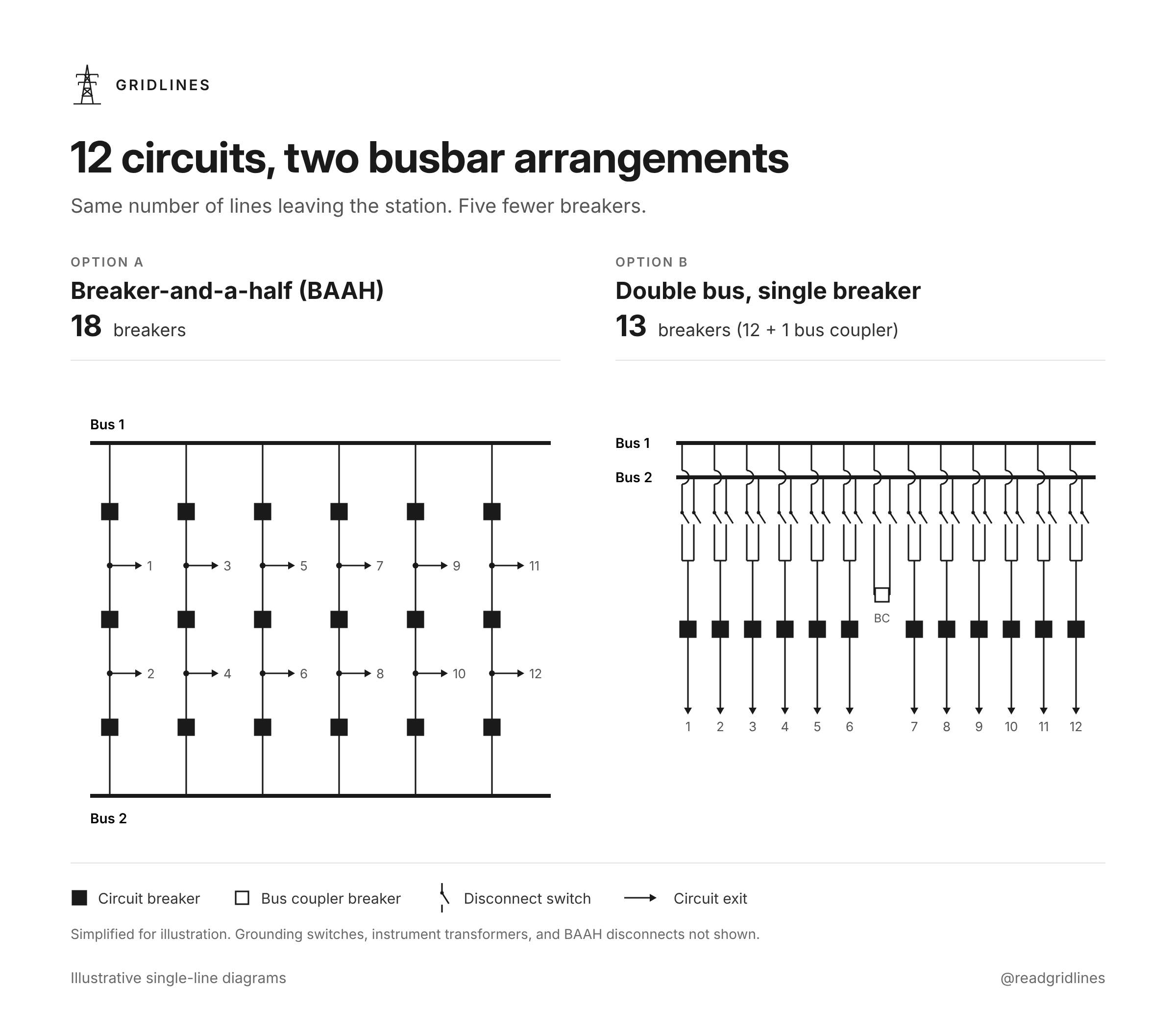
To see how much this matters, take twelve circuits. Breaker-and-a-half needs 18 breakers. Double bus single breaker needs 12, plus one for the bus coupler. Same number of lines leaving the station, five fewer breakers. The additional equipment affects cost and physical layout, which makes the busbar configuration an important consideration when developing an RFQ, particularly for installations with limited space.
2. Define the Electrical Ratings
Ratings can get lost in translation, usually because someone enters the nominal system voltage in the rated voltage field. Nominal is what the grid runs at, say 138 kV or 230 kV. Rated voltage is the maximum the equipment is designed for, which is the next standard step up: 145 kV for a 138 kV system, 245 kV for 230 kV. Voltage is a required field for the OEM to select the appropriate model.
Beyond voltage, here’s what they’ll need:
Continuous current, for the main busbar and for each circuit. The bus might be 4000 A while the feeders are 2000 A. Don’t assume one number covers everything.
Short-circuit breaking current, in kA. This sizes the interrupter.
Short-time withstand current and duration, for example 40 kA for 3 seconds. IEC and IEEE don’t default to the same duration, so write it down.
Insulation level, meaning the lightning impulse withstand (BIL) and power-frequency withstand. Some voltage classes offer more than one level, so don’t leave it to the OEM to pick.
Frequency, 50 or 60 Hz. Obvious, until a global supplier’s quoting template assumes the other one.
Applicable standards, IEC 62271-203 or IEEE C37.122, plus any utility-specific spec.
These numbers decide which product platform the OEM can even offer. Ask for 63 kA when 40 kA would do and you may push the bid into a bigger enclosure with a higher price and a longer lead time. Under-specify and you get a quote that falls apart at technical review, and the whole cycle starts over.
3. Identify the Termination Points
Every circuit has to leave the GIS somehow, and the OEM needs to know how for each one. A station with some cable exits and some overhead exits is completely normal, so a per-circuit list beats a single line in the spec.
Cable terminations. The circuit leaves as underground cable. The OEM needs the cable size and type, and someone needs to decide who supplies the termination kit, since that interface sits right between the GIS supplier and the cable supplier.
SF6-to-air bushings. The circuit connects to an overhead line or outdoor equipment. Bushings need electrical clearances, which adds height and footprint, and on an indoor install they mean either a wall penetration or a run out to the yard.
Gas insulated bus duct (GIB). Used when the connection point is somewhere the bay can’t reach directly, like a bushing on the far side of a building or a transformer across the yard. GIB is priced by the meter, so even a rough routing sketch helps.
Direct transformer connection. The GIS bolts straight onto the transformer, which needs coordination with the transformer manufacturer before either design is frozen.
Termination type changes the end module of the bay, the layout, and sometimes the building itself. It also tells the OEM where their scope stops and someone else’s starts, and that’s exactly the kind of boundary that turns into a finger-pointing exercise on site if nobody draws it early.
4. Don’t Overlook Instrument Transformers
In an air insulated yard, if you forgot a CT you can usually add a freestanding one later. In GIS the CTs are rings sitting around the conductor inside the enclosure, so adding one after the fact is a real project. That’s why CT details belong in the RFQ and not in a post-award email.
For each CT location, the OEM needs:
Ratio, including whether you want multi-ratio taps.
Number of cores, and what each one is for, protection or metering.
Accuracy class per core, like C800 or 5P20 for protection and 0.3 or 0.2 for metering.
Burden.
Location in the bay, for example on both sides of the breaker so protection zones overlap.
More cores means a longer CT housing, which can stretch the bay, so this isn’t just a relay engineer’s problem. It’s also worth asking whether you need extra CTs at the line exits. A breaker-and-a-half scheme, for instance, can call for a dedicated line CT instead of summing the two breaker CTs, and revenue metering at a point of interconnection may need its own.
Voltage transformers are simpler but still need quantities, locations (line side, bus side, or both), ratios, and accuracy. Line VTs often do double duty for synchronizing, so say if that’s the plan.
Together these decide how the GIS talks to your protection and control system. Get them wrong and the error doesn’t show up until the relay settings don’t make sense.
5. Account for Special Switching Requirements
Some circuits need more than a standard breaker, and finding that out after award means a change order and, usually, a schedule hit.
Pre-insertion resistors (PIRs) briefly put a resistor in the circuit as the breaker closes, which limits switching overvoltages. You’ll see them mostly on breakers that energize long transmission lines. They add a physical assembly to the breaker, so they can change the design and the price.
Controlled switching devices (CSDs), also called point-on-wave controllers, time each pole’s operation to a specific point on the voltage or current waveform. They’re common on circuits switching shunt reactors, capacitor banks, or transformers, where a badly timed operation means big inrush currents or transients. A CSD needs a breaker with consistent mechanical timing and its own controller, and not every breaker in a product line qualifies.
The easiest fix is to tell the OEM what each circuit feeds. “Circuit 7 connects to a capacitor bank” is more useful than a blank field, because it lets them flag the requirement and price it on day one.
6. What Else Belongs in the RFQ?
To get an accurate budgetary price and a clean start on drawings, there’s a lot more the OEM will want to confirm with you. Anything you leave out, they’ll either ask about or list as an assumption in the bid clarifications. Every one of those assumptions is a place the price can move later.
Indoor or outdoor. This changes the enclosure, the auxiliary equipment, and how the switchgear gets installed.
Footprint and layout limits. If it’s going into an existing building, send the dimensions, door and crane access, and floor loading. If it’s new, send whatever site plans exist, including grade changes.
Site conditions. Ambient temperature range, altitude, seismic zone, and pollution level all affect the design.
Control voltage and the protection and control interface, including communication protocols.
Standards and utility-specific requirements beyond the ones already covered under ratings.
Insulating gas. If the project is somewhere phasing out SF6, or the owner has a corporate commitment to avoid it, say so up front. It narrows the field fast.
Future expansion. Spare bays, or at least a bus end designed to extend, cost far less now than later.
Installation, testing, commissioning, and documentation scope. Spell out who does what on site.
Your preferred T&Cs. Send them with the RFQ so legal redlining can run in parallel with the technical review instead of after it.
A complete RFQ won’t get you out of every clarification call. With equipment of such scale, there will always be good questions to ask. What it does is let the OEM’s engineers start on your actual design instead of reconstructing it, so the budgetary price you get back is one they can stand behind and the first set of drawings is closer to the last.
Target Audience
Utilities, EPC firms, consulting engineers, and commercial and industrial buyers procuring high-voltage gas-insulated switchgear.
Project Overview
A technical explainer examining the transition toward SF₆-free gas-insulated switchgear, the differences between emerging technologies, and the engineering and commercial considerations influencing equipment selection.
PORTFOLIO NOTE
PORTFOLIO NOTE: A practical buyer's guide outlining the technical information OEMs need to develop an accurate GIS quotation. The piece translates complex equipment specifications and engineering requirements into actionable guidance, helping buyers prepare more comprehensive inquiries and streamline the procurement process.
WRITING SAMPLE
Before You Request a GIS Quote: What Your OEM Needs to Know
An engineer's guide to the technical information manufacturers need to develop an accurate high-voltage GIS proposal.
Your expertise. Thoughtfully articulated.
GridLines helps energy and industrial companies communicate complex ideas, establish industry authority, and turn technical expertise into compelling content.
Every engagement begins with a conversation about your business, audience, and content goals.
Service packages and rates available upon request.